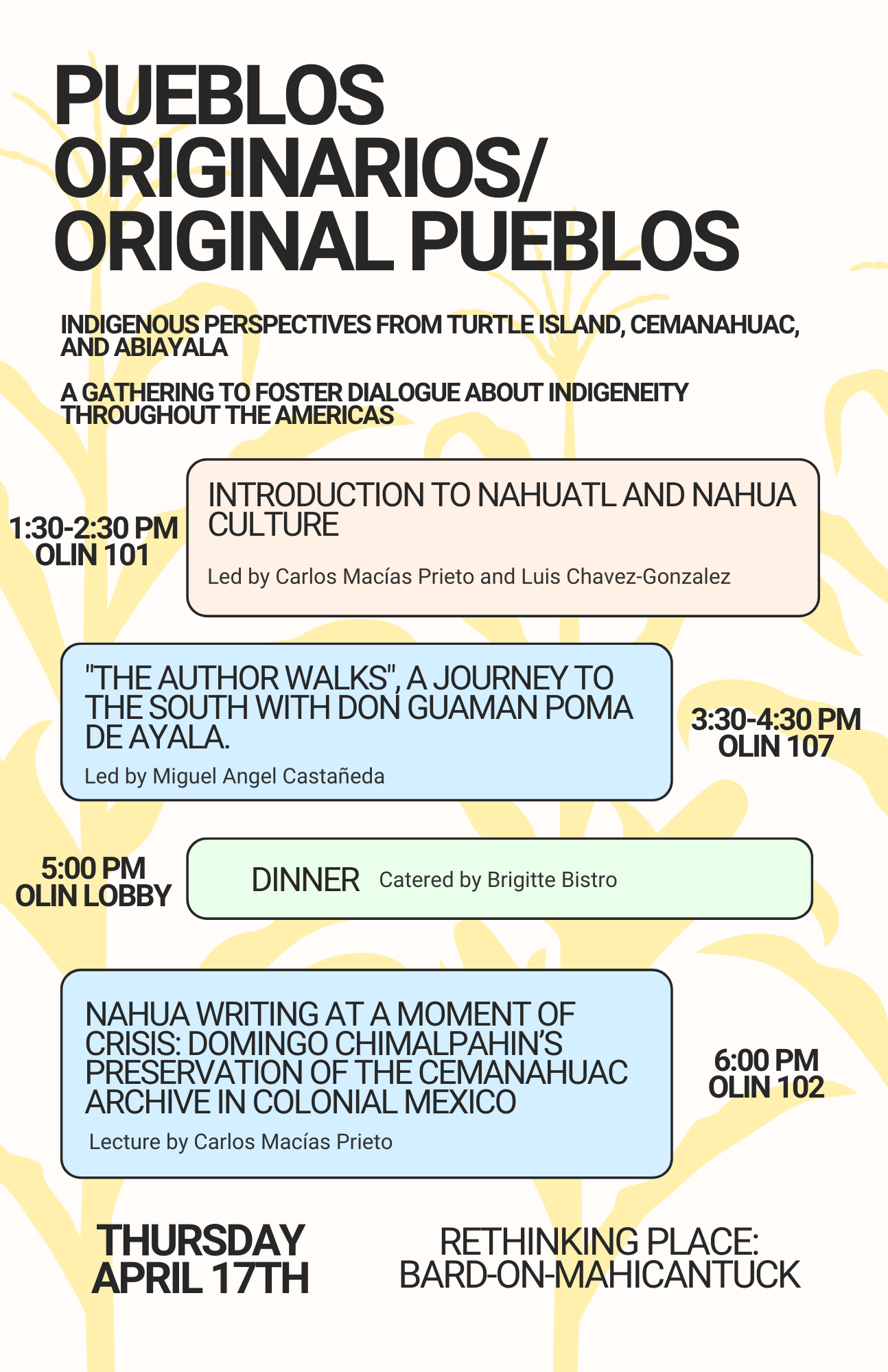
American and Indigenous Studies Program Presents
Nahua (Aztec) Writing After the Conquest: Domingo Chimalpahin and the Cemanahuac Archive in Colonial Mexico
Thursday, April 17, 2025
Olin 102
6:00 pm EDT/GMT-4
Part of Pueblos Originarios/Original Pueblos: Indigenous Perspectives from Turtle Island, Cemanahuac, and Abiayala. A gathering to foster dialogue about Indigeneity throughout the Americas.6:00 pm EDT/GMT-4
This presentation examines the writings of don Domingo de San Antón Muñón
Chimalpahin Quauhtlehuanitzin (hereafter Chimalpahin), a Nahua tlacuilo (scribe) who
produced the largest body of written texts in Nahuatl and Spanish among Nahua (Aztec) writers
of the sixteenth and seventeenth centuries; it illustrates that Chimalpahin refutes Spanish
historiography by revising and extending the narratives of Spanish, castizo, mestizo, and
Indigenous authors, all while placing Indigenous history in a global context. By framing
Chimalpahin’s work as a forward-looking endeavor, Chimalpahin’s writing encourages us to
reconsider Nahua intellectual production at the turn of the seventeenth century and as a starting
point from which to imagine alternative futures that support Indigenous struggles for land and
self-determination.
Professor Carlos Macías Prieto is Assistant Professor of Spanish and Faculty Affiliate in the
Latina/o Studies Program at Williams College. He received his Ph.D. in Hispanic Languages and
Literatures in the Department of Spanish and Portuguese at UC Berkeley in 2020. Prior to his
graduate studies at Berkeley, he completed a master’s degree in American Studies from Purdue
University. Professor Macías Prieto’s book manuscript Nahua Writing at a Moment of Crisis:
Domingo Chimalpahin’s Preservation of the Cemanahuac Archive in Colonial Mexico (under
contract with Vanderbilt University Press), examines the writings of don Domingo de San Antón
Muñón Chimalpahin Quauhtlehuanitzin (hereafter Chimalpahin), a Nahua scribe who produced
the largest body of written texts in Nahuatl and Spanish among Nahua writers of the sixteenth
and seventeenth centuries. It traces an Indigenous intellectual project that diverges from that of
European authors who sought to appropriate native history to legitimize themselves as the
rightful rulers of the land. Nahua Writing at a Moment of Crisis argues that Chimalpahin’s
oeuvre reveals a unique Indigenous intellectual project, written in Nahuatl for Nahua readers of
the future. And it shows that Chimalpahin’s project safeguarded the Indigenous history of
Cemanahuac—the Indigenous world as seen by the Nahuas— making it possible for future
generations of Nahuas to reclaim their Indigenous history, language, and land.
For more information, call 845-758-6822, or e-mail [email protected].
Time: 6:00 pm EDT/GMT-4
Location: Olin 102
 Save this Event: